


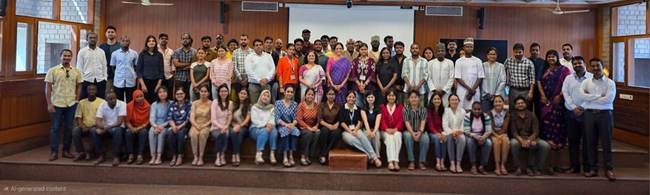
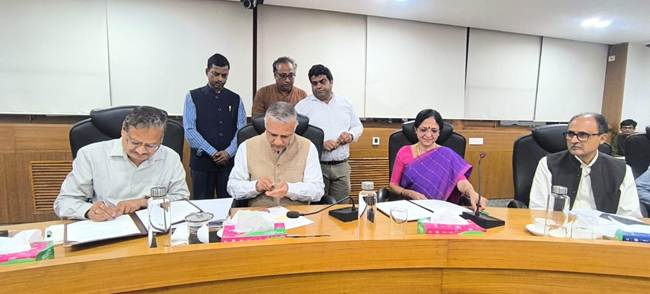
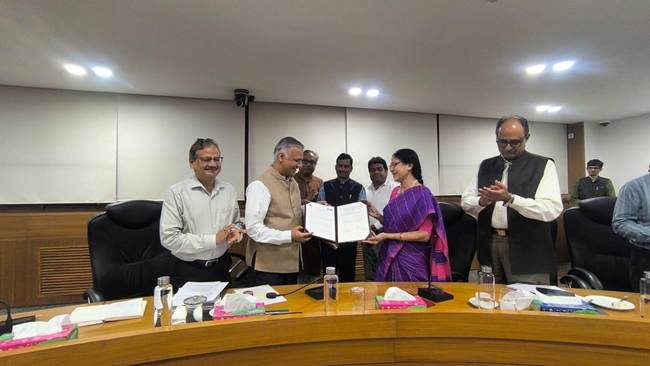
Nālandā University (NU) and the CSIR–Traditional Knowledge Digital Library (CSIR-TKDL) Unit have signed a Memorandum of Understanding today to establish a structured collaboration for academic, research and capacity-building cooperation in the areas of Traditional Knowledge (TK), Intellectual Property Rights (IPR), People’s Rights and Cultural Heritage, including Traditional Cultural Expressions (TCEs). The MoU was signed by Prof. Sachin Chaturvedi, Vice Chancellor, Nālandā University and Dr. Viswajanani J Sattigeri, Scientist-H and Head, CSIR-TKDL Unit, in the presence of the faculty members of the Nālandā University and senior officials of the CSIR-TKDL Unit.
Through the collaboration, the two organizations, Nālandā University and CSIR-TKDL Unit shall draw together their individual strengths to address their common interests on matters of TK, IPR, cultural heritage including the TCEs of Bihar. The cooperation shall focus on academic and research activities and intellectual exchanges, trainings, student internship and exchange visits and networking, among others.
Speaking on the occasion, Prof. Chaturvedi, Vice-Chancellor, Nālandā University, appreciated the significant efforts of the CSIR on the TKDL and its role in preventing the misappropriation India’s TK. He further noted that this collaboration would strengthen efforts to identify, document and disseminate TK and TCEs while creating greater awareness about IPRs and also training the younger generation on the matter. He highlighted the importance of systematically documenting, preserving, and making TK across subject areas such as ecological knoweldge of the communities, folklore, music, and others. He also opined that the TK may be made accessible in a manner that safeguards the interests of knowledge holders and communities, as well as the organizations’ commitment to evidence based R&D in Indian Knowledge Systems (IKS). He observed that the collaboration with TKDL would provide an important platform for integrating TK with contemporary academic research, documentation, IP awareness and interdisciplinary scholarship.
Dr. Sattigeri, Head, CSIR-TKDL Unit stated that India has been leading globally on all matters of TK, be it policies or initiatives such as the TKDL. She stated that the ancient Nālandā University speaks of the importance of collaboration between organizations, both nationally and internationally. This collaboration between CSIR-TKDL Unit with the new Nālandā University is envisaged to rejuvenate the past glory of Nalanda as both educational and research hub, with specific focus on the cultural heritage of India, and particularly, Bihar.
The Parties are confident that the collaboration between Nālandā University and CSIR-TKDL Unit will contribute to the attainment of the objectives of the National Education Policy (NEP) 2020 and National IPR Policy 2016 on TK, IPR and cultural heritage.
About Nālandā University:
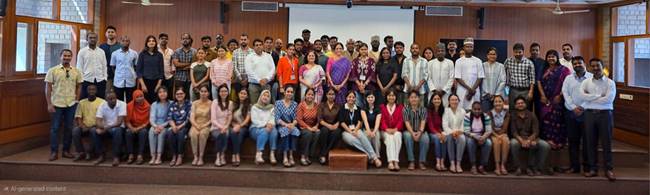
Nālandā University has been established as an International University of “National Importance” under the aegis of the Ministry of External Affairs, Govt of India, at Rajgir, District-Nalanda, Bihar. The objectives of Nālandā University, deriving on its ancient heritage value and strong international cooperation, are focused on the pursuit of intellectual, philosophical, historical and spiritual studies and others. The revival of Nālandā University aims at improving regional understanding and the appreciation of one another’s heritage and history, to build a community of learning where students, scholars, researchers and academicians can work together symbolizing the spirituality that unites all mankind.
About TKDL:
The TKDL database, first of its kind worldwide, was established in 2001 by the Government of India, through a collaboration between CSIR and Ministry of AYUSH. The key objective of the TKDL is to prevent the erroneous grant of patents on Indian traditional knowledge (TK) and deter misappropriation of the country’s heritage. Currently, the TKDL contains information on over 5.2 lakh formulations and practices of Indian Systems of Medicine such as Ayurveda, Unani, Siddha, and Sowa Rigpa as well as Yoga from the traditional texts. The TK information from diverse languages and subject areas are transcribed into value-added information correlated with modern terminologies.
The TKDL information is presented in a digitized format in five international languages including English, German, French, Japanese and Spanish, therein breaking language and format barriers for ease of use by patent examiners. Currently, the TKDL database is available to 18 international patent offices through Non-Disclosure Agreements.
The TKDL is a global benchmark in the defensive protection of traditional knowledge and has been successful in protecting India’s interest against any possible misuse of its heritage. The impact has been significant, with over 375 patent applications world-over being revoked, rejected, amended, withdrawn or abandoned, based on the prior art evidences presented from the TKDL database.